PhD Defence Juliane Sørensen
Dynamic Enzymatic Synthesis of Unnatural Cyclodextrins
Abstract:
Cyclodextrins (CDs) cyclic carbohydrates with donut-like shapes composed of connected glucose monomers. They are water-soluble and can have different ring sizes depending on the number of glucose monomers in the ring. CDs can encapsulate small molecules, a property that is widely used in the pharmaceutical, food, and cosmetics industries to improve the solubility, stability, and delivery of active ingredients such as drug molecules. Despite their importance, the synthesis of selectively modified CDs with tailored properties remains challenging due to many funcional groups possessing similar reactivities. Traditional chemical methods often require many reaction steps and extensive use of hazardous chemicals.
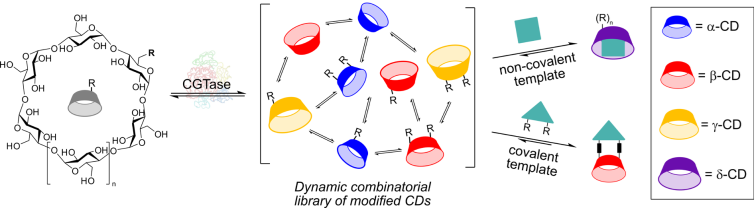
This PhD project explores a more sustainable alternative to the synthesis of modified CDs, based on enzymes which are Nature’s own catalysts. The enzyme cyclodextrin glucanotransferase (CGTase) can ring-open and close CDs in a dynamic way. This means that when modified CDs are treated with CGTase, an interconverting mixture of different ring sizes and number of modifications is formed, as shown in the figure.
In this work, CDs with different modifications were investigated, including both negatively and positively charged functional groups. The composition of the system could be controlled by template molecules, that either bind inside the CD cavity or via the modified glucose units. Different template strategies were explored to selectively synthesise modified CDs of specific ring sizes and moreover, with a controlled number of modifed glucose units with specific locations in the CD ring.
Kontakt
Juliane Sørensen Postdoc Institut for Kemi Mobil: 20552238 julias@kemi.dtu.dk
Sophie Beeren Professor Institut for Kemi Telefon: 45252123 Mobil: 22592785 sopbee@kemi.dtu.dk